How to Reduce Support Tickets: A Ticket Deflection Playbook
The cheapest support ticket is the one that never reaches you. A practical ticket deflection playbook to cut support volume with a help center, status page, roadmap, and AI, without hurting customers.
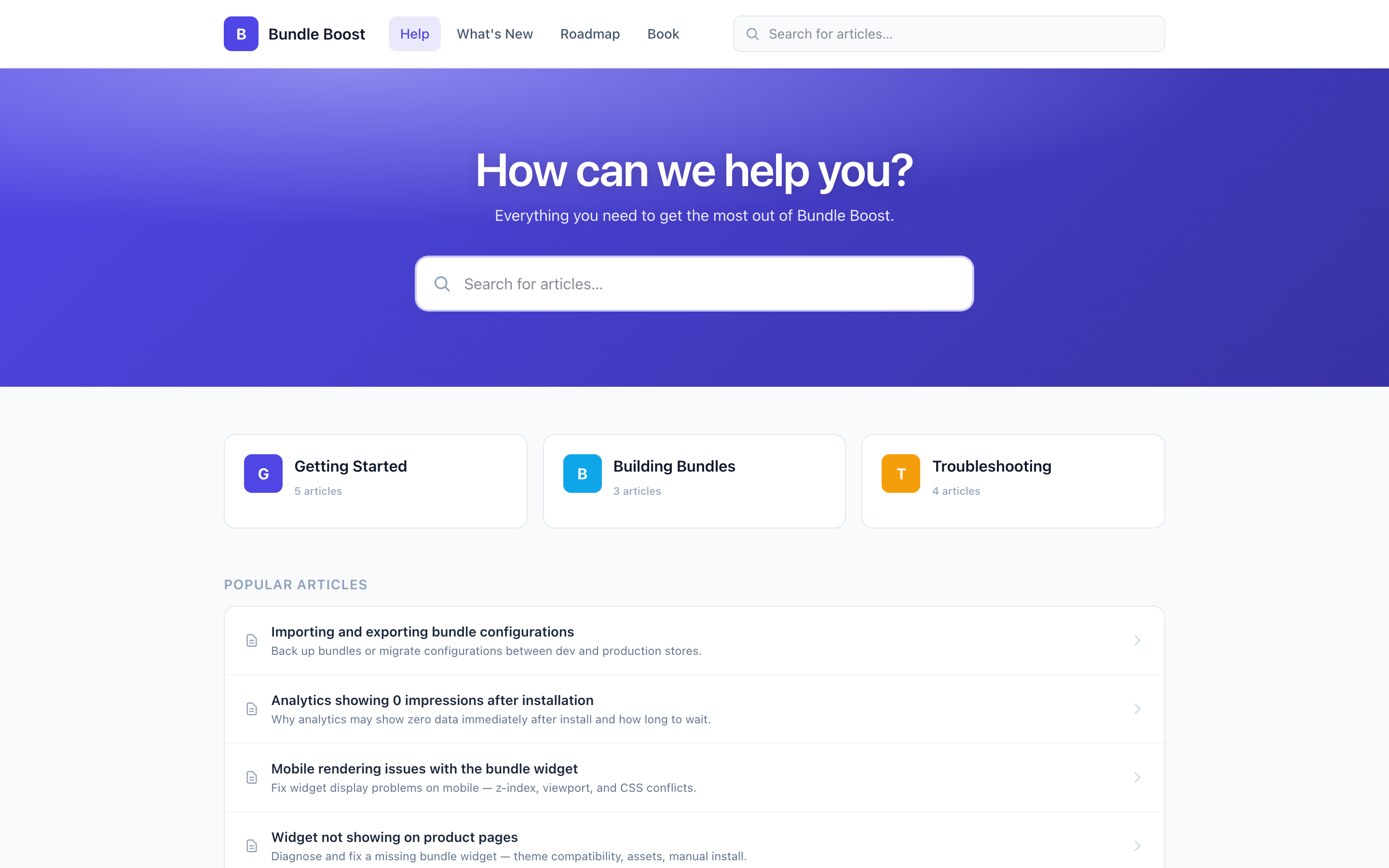
A small team cannot answer its way out of growth. As your customer base climbs, ticket volume climbs with it, and at some point you are spending all day in the inbox and none on the product. Hiring more agents buys time but not leverage. The durable fix is ticket deflection: helping customers solve their own problems before they ever open a conversation.
Done well, deflection means your support volume grows much slower than your customer base. That gap is what lets a three-person team support thousands of customers without drowning. Here is how to build it, and how to measure whether it is working.
What ticket deflection actually means
Deflection is not about making support harder to reach or hiding the contact button. That just produces angry customers and worse reviews. Real deflection means a customer gets a complete answer faster on their own than they would by waiting for you. You win, they win. For the broader picture of how deflection fits into SaaS Customer Support: A Practical Guide for Lean Teams, that guide covers channels, metrics, and the build-vs-buy decisions too.
You can measure it. Ticket deflection rate is the share of help-seeking sessions that end with a self-serve answer instead of a new conversation. A rough formula: help-center sessions that did not create a ticket, divided by total help-seeking sessions. Track it as a trend, not an absolute, and watch it climb as you add content. If conversations stay flat while your customer base grows, deflection is doing its job.
1. Answer the repeat questions with a help center
Most of your tickets are the same handful of questions asked over and over. Each one is an article waiting to be written. Start by listing your ten most common questions, then write each as a single clear article with the exact answer up top and the detail below.
The placement matters as much as the content. A help center embedded inside your chat widget catches the question at the moment of friction, so the customer finds the answer instead of messaging you. A help center buried in a footer nobody visits deflects almost nothing. Put it where the question is asked.
2. Structure the help center so people actually find answers
A pile of articles is not a help center. Deflection lives or dies on findability:
- Title every article as the question the customer asks, in their words, not internal jargon. “Why is my store not syncing?” beats “Sync troubleshooting.”
- Lead with the answer. Put the fix in the first two lines; save the background for below. People scan, they do not read.
- One article, one job. A page that tries to answer five questions ranks for none of them and confuses the reader.
- Make search excellent. If a customer types two words and does not see the right article, the article does not exist as far as they are concerned.
- Keep a shallow structure. A few clear categories beat a deep tree nobody can navigate.
3. Cut “is it down?” tickets with a status page
During any outage or degraded performance, a large chunk of incoming tickets are just “is it only me?” A status page with uptime monitoring answers that publicly. One update replaces dozens of identical messages, and it buys goodwill, because customers would rather see an honest “we are on it” than silence.
4. Reduce “when are you adding X?” with a public roadmap
Feature questions are another recurring category: “are you working on X?” and “what changed?” A public roadmap and changelog answers both before anyone asks, and it doubles as a retention signal that your product is alive and improving. Let customers vote on what is next and you convert a support burden into a product-research channel.
5. Prevent the question with proactive, in-product help
The cheapest deflection happens before the customer even forms a question. Contextual help, a tooltip on the confusing field, a one-line explainer on an empty state, a “need a hand connecting your store?” nudge at a known sticking point, removes the friction at the source. The best support ticket is the one the product made unnecessary. Watch where new customers stall in their first session, that cluster is usually your single biggest ticket generator, and an in-product fix there pays off forever.
6. Let AI handle the routine, not the judgment
For the questions that still come through, a grounded AI agent can answer the routine ones from your own help content, so a human only handles the conversations that genuinely need judgment. The word “grounded” matters: an agent that answers from your documented knowledge deflects safely, while one that improvises invents wrong answers and creates more tickets than it removes. Keep clear escalation rules so anything sensitive reaches a person, and feed the AI the same help center your customers search, so both improve together.
Measure what still gets through, then close the gap
Deflection is a loop, not a launch. Two habits keep it improving:
- Watch the questions that reach your inbox despite an article existing. Usually the article is hard to find or unclear. Rewrite it or surface it earlier.
- Track searches that return nothing. Every empty search is a customer telling you exactly which article to write next.
This is where deflection connects to the rest of your numbers. As you cut volume, your first response and resolution times on the remaining tickets should improve, because your team has room to handle the hard ones fast.
The balance: deflect without frustrating
Deflection has a failure mode: pushing self-serve so hard that a customer who genuinely needs a human cannot find one. That is not deflection, it is churn with extra steps. Always keep the path to a person one click away, and treat a customer who escalates after reading three articles as a signal that those articles failed, not as a nuisance. Good deflection feels like help, not a wall.
A quick deflection checklist
- Top ten questions written as findable articles
- Help center embedded in the widget, not buried in a footer
- Search that returns the right answer for two-word queries
- Status page for “is it down?” tickets
- Public roadmap/changelog for “when are you adding X?”
- Proactive in-product help at known friction points
- A grounded AI agent for the routine, with clear escalation
- A weekly look at failed searches and articles that are not deflecting
The payoff for a lean team
When deflection works, the math changes. Support volume decouples from headcount, your best people spend their time on the conversations that actually need them, and you get your days back to build the product instead of answering the same question for the hundredth time. It also protects revenue: fast, low-effort help is one of the quietest drivers of retention, which we cover in how to reduce customer churn.
Convot bundles the whole self-serve layer, a help center, status page, roadmap and changelog, and a grounded AI agent, under one login and one bill, so a small team can deflect like a big one.
Start free and build the layer that answers for you.
Revenue-aware support for Shopify app teams.
Live chat, help center, and every merchant's MRR, plan, and LTV beside the conversation. Free under $1k MRR.
Start free