Building the knowledge base for a SaaS product: structure, upkeep and AI (2026)
How to build a knowledge base an AI agent can answer from: structure by customer job, an article template, a testing loop and real Appointo hand-off data.
On this page
- Key takeaways
- Why do knowledge bases underperform?
- How should you structure a knowledge base?
- How do you write articles an AI agent can answer from?
- How do you keep a knowledge base up to date?
- How should AI use your knowledge base?
- Should you consolidate your support tools?
- How do you translate a knowledge base?
- How do you measure whether a knowledge base works?
- FAQ
To build a knowledge base an AI agent can answer from, organise articles around the jobs customers try to do, give each article one question, a first-sentence answer, the conditions it applies to and an escalation rule, then retest it against real support questions after each release. On Appointo, Sidepanda’s own app with 83 help articles, our agent escalated 29% of 808 messages.
Key takeaways
- Structure by customer job, such as “connect your store” or “fix a failed sync”, not by internal team.
- Write each article for an agent as well as a reader: one question, the answer in the first sentence, the conditions it applies to, a failure path and an escalation rule.
- Test answers, not article counts: run 50 to 100 real support questions (our rule of thumb) against search or AI and fix what fails.
- Ground AI in the knowledge base, show which article it used and hand off when the evidence is thin. The hand-offs are your to-do list.
- Translate by demand, starting with the procedures customers in that language actually need.
For what knowledge base software costs a small team and how to migrate, see knowledge base software for small software teams. This page covers the other half: how to structure and write the articles themselves.
Imagine a small SaaS team that ships a 40-article help center. A week later, customers are still asking where to change a plan, whether a feature works on their version, and what to do when the documented fix fails. The help center exists, but it doesn’t do the work.
Building the knowledge base is less about producing more articles and more about proving that customers can find, trust, and apply the right answer. The difficult part starts after launch. Small teams need a system for testing real questions, handling uncertainty, assigning ownership, and removing stale instructions before they create new tickets.
Why do knowledge bases underperform?
In our view, knowledge bases underperform when nobody owns them after launch, so articles go stale, answers stay in inboxes and chat threads, and nothing tests whether customers can act on what they read. A new help center looks finished early: the categories are tidy and the founder can answer every question because the founder built the product.
Gartner measured self-service outcomes and agent behaviour, not who owns the help center, so treat ownership as our view and the numbers as context. Gartner found that only 14% of customer service issues are fully resolved in self-service (Aug 2024, 5,728 customers), and 60% of service agents fail to point customers to it (Jun 2025, 5,801 customers). Gartner’s analyst tied agent promotion to a doubling of the number of customers likely to adopt self-service next time.
Publishing makes answers visible. It does not test whether anyone can use them.
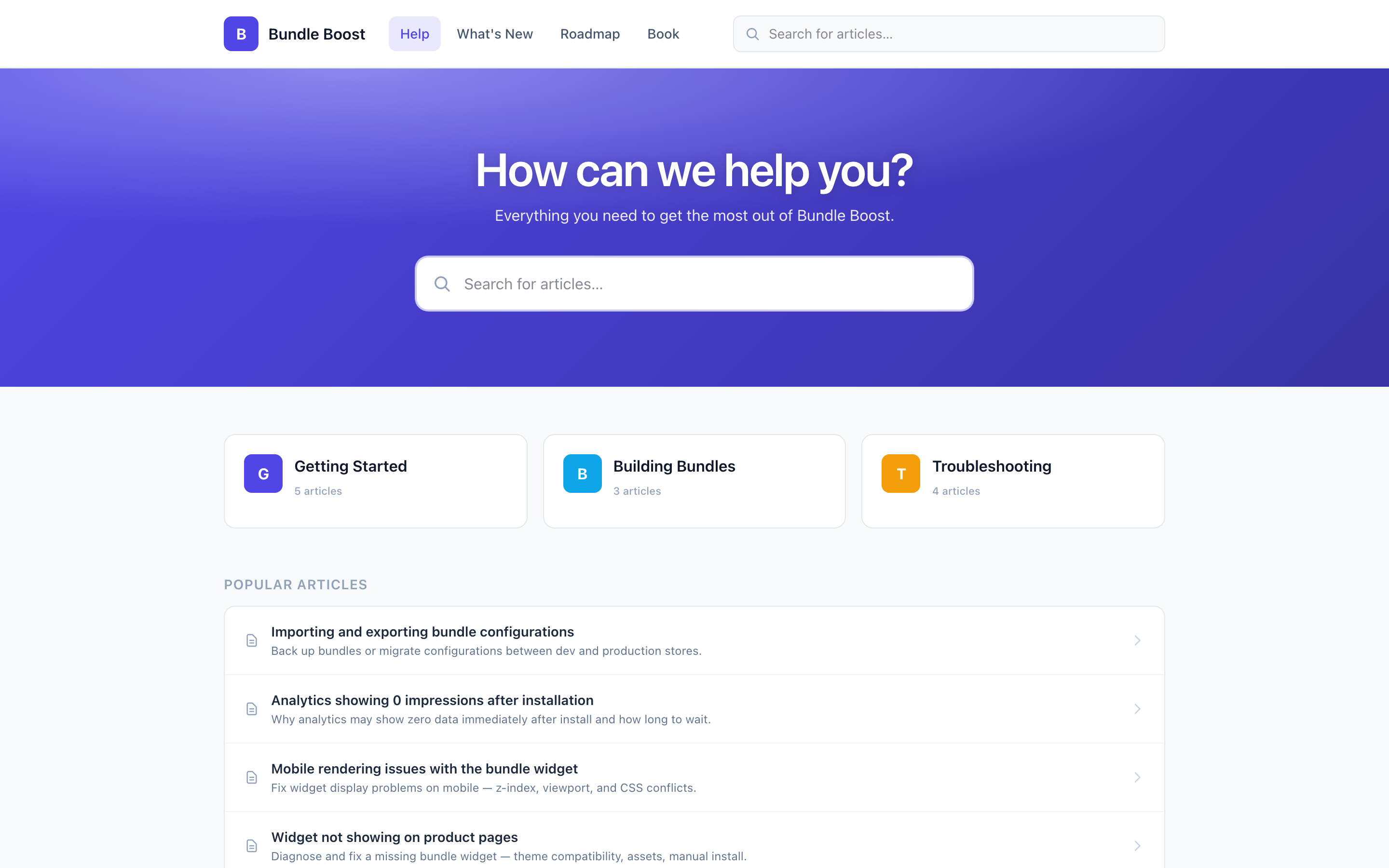 A Convot help center: search first, then categories named after customer jobs, then popular articles.
An archive stores answers, a system delivers them
A published article is not the same as a working answer. An article can be technically correct and still fail if nobody owns it, customers can’t find it, or the answer doesn’t match the situation in front of them. A billing article needs plan context. A troubleshooting article needs version context. A security article needs a clear handoff instead of a confident guess. For real front-page patterns to borrow, see FAQ example pages from Shopify, Slack, Zoom and others.
Practical rule: An article is finished only when a real user can find it, understand it, and take the intended next step.
Give every answer a place in the workflow
A living knowledge base needs more than article pages. It needs a named owner, a review condition, an escalation path, and a connection to the conversations that generated the answer. Without those links, documentation becomes a quiet archive that grows while its usefulness declines.
Start with the questions customers ask repeatedly. Include questions the system should refuse to answer. A support agent should know that an uncertain answer about an outage, account security issue, billing dispute, or ambiguous technical incident requires a human. That refusal boundary belongs in the knowledge system, not only in an agent’s memory.
For each new article, record the situation it solves, the audience it serves, the product conditions that affect the answer, and the next action when the article doesn’t apply. That structure turns documentation into an operating layer for support. It also gives the team something testable later, instead of a collection of polished pages with no clear standard of success.
How should you structure a knowledge base?
Structure a knowledge base around the jobs customers try to do, with a small top level, clear titles and the words customers actually type. The first structural decision is where a customer should look when they don’t know your internal vocabulary. Organize around jobs, not departments. “Connect your store,” “understand billing,” and “fix a failed sync” are usually better starting points than “engineering,” “operations,” and “product.”
Broad categories help users orient themselves. Deep hierarchies make precise topics easier to isolate but harder to browse. Keep the top level small enough to scan, then use article titles, tags, synonyms, and related links to carry the detail. A customer shouldn’t need to understand your product architecture before asking for help.
Choose a structure that reflects real questions
A useful initial structure includes:
- Getting started: Setup, installation, permissions, and the first successful outcome.
- Core workflows: The jobs customers perform repeatedly.
- Troubleshooting: Symptoms, causes, checks, and escalation conditions.
- Billing and account: Plans, invoices, usage, cancellations, and access.
- Reference: Limits, integrations, definitions, and version-specific behavior.
Name these sections in your customers’ words, not your company’s. A founder who is also out raising, and reading guides to find early stage investors, should keep that pitch language out of the help center. Customers search using the problem they have.
Make templates enforce clarity
A template should prevent omission, not make every article sound identical. Require fields that affect whether an answer can be trusted:
- Outcome: What the reader will accomplish.
- Applies to: Product, plan, version, role, or integration conditions.
- Steps: The shortest safe path to the result.
- Expected result: What the customer should see.
- Failure path: What to check if the result doesn’t appear.
- Escalation rule: When a human must take over.
- Owner and verification date: Who maintains the answer and when it was last checked.
- Related changes: Links to relevant release notes or incidents.
Use exact error messages, alternate customer wording, product names, and plan terms in the article. Write for both exact matches and paraphrases. The content structure still comes first. Poorly labeled sources produce poor retrieval, no matter how polished the search tool looks.
How do you write articles an AI agent can answer from?
Write each article so a single passage answers a single question, with its conditions stated in the text. An agent retrieves passages, not pages, so a step that depends on a plan, a version or an earlier paragraph fails when it is read alone. These rules are our working practice, not a published standard.
- One question per article. If a page answers “how do I connect my store” and “why did my sync fail”, split it. Two questions in one page give the agent two chances to quote the wrong half.
- Title it as the customer would ask it. “Fix a failed sync” beats “Sync architecture”.
- Answer in the first sentence, then the steps. The first sentence is the part most likely to be quoted.
- State the condition inside the sentence. Write “On the Pro plan, you can…” instead of leaving the plan in a table two screens up.
- Put the instruction in text, not only in a screenshot. Add the screenshot beside it.
- Write the stop line. End troubleshooting articles with “If this does not work, contact support with your order number.” That line is what lets an agent hand off instead of guessing.
- One canonical article per issue. Two pages that disagree make an agent choose at random.
Then check what the agent did with them. Appointo is one of Sidepanda’s own Shopify apps, and its help center holds 83 published articles in Convot. In the 30 days to 14 October 2026, Cove AI evaluated 808 customer messages. It answered 16% directly, drafted a reply for a person on 55%, and escalated 29% after abstaining below its confidence threshold.
Convot production data, Appointo (Sidepanda’s own app), 30 days to 14 Oct 2026. Rates are shares of 808 customer messages, counted per message and not per conversation.
The 29% comes from one app and one 30-day window, and an abstention can mean a missing article or a question the agent should not answer, so it is an upper bound on content gaps. It is still the most useful list we have: 235 messages Cove escalated, which we have not split by cause. Cove shows the customer which article it used, so a wrong answer traces back to one page to fix. How Cove picks its sources is in how Cove AI grounds its answers.
For a Shopify-specific walkthrough, see how to build a help center for your Shopify app. The broader rule applies to any SaaS product: write around customer intent, then attach the product conditions that change the answer.
How do you keep a knowledge base up to date?
Keep a knowledge base up to date with a loop: collect real questions, test them against the help center, fix what fails, and give every article an owner and a review date. A help center decays through small changes. A button moves. A plan is renamed. An integration changes its permissions. A release fixes the issue described in an old troubleshooting article, but the article remains live and sends customers down the wrong path.
Treat the agent’s hand-offs as the first input. Pull the messages it escalated last month, group them by topic, and write or fix one article per group.
The maintenance loop begins with actual support conversations, not an editorial calendar. Collect 50 to 100 real support questions (our rule of thumb, not a sourced number) from your inbox, chat, tickets, or call notes. Label the ideal answer, the source that should support it, and the condition that requires escalation. Keep the set stable enough to test after each release.
The loop, in five steps:
- Audit articles for outdated answers.
- Flag the stale or weak pages.
- Update them.
- Review accuracy with whoever owns the feature.
- Republish and tell affected users.
Test answers, not article counts
Run the question set against your search or AI workflow after each release. You don’t need a large research department. A spreadsheet works if it captures the question, expected answer, returned answer, citations, confidence, and escalation result.
Watch for four failure types:
- Unanswered intent: The system retrieves nothing useful.
- Wrong source: The response cites content that doesn’t apply to the product state.
- Incomplete answer: The response gives steps but omits a prerequisite or exception.
- Unsafe confidence: The response answers an ambiguous or restricted question instead of handing off.
Slow updates and conflicting sources are especially common in small teams because the person changing the product isn’t always the person maintaining the help center. Assign one owner for every correction, add a review date, and link the fix to the release or support conversation that caused it.
A useful maintenance record includes the question, the expected answer, the evidence source, the owner, the review date, and the reason for the change.
Turn failed conversations into durable fixes
Don’t only revise the article that failed. Check why the failure occurred. The answer may be hidden under an internal term, split across two conflicting pages, missing a version label, or absent from the index entirely.
A monthly review should identify the questions that keep returning, pages that produce low-confidence answers, articles with outdated links, and topics that require repeated human explanation. Archive contradictory pages rather than leaving both available. One canonical article per issue is easier for customers, agents, and retrieval systems to trust.
Teams that want a more complete support operating model can also review ways to reduce support ticket volume through self-service. Remove predictable friction, and keep a clear human path for cases that need judgment.
How should AI use your knowledge base?
AI should answer only from your knowledge base, show which article it used, and hand off to a person when the evidence is thin. AI can answer from a knowledge base, but it can’t repair an ownership problem. If the source material is contradictory, stale, or missing the conditions that matter, an agent can produce a fluent answer that creates more work.
Prices for AI answering, such as Intercom’s Fin and Cove AI, are compared in knowledge base software for small software teams. A lower price doesn’t remove the need to check answer quality, source coverage and escalation behaviour. AI support agents that cite their sources compares how vendors handle that.
Grounding needs visible evidence
A grounded agent should answer from the team’s documentation, cite the source it used, and stop when the evidence doesn’t support a safe answer. Source citations help the customer and the support team inspect the reasoning. They also expose weak content quickly. If an answer repeatedly cites a vague setup page, the problem may be the article structure rather than the model.
Keep automation narrow where the cost of error is high. Billing disputes, account security, outages, permission changes, and ambiguous technical incidents need explicit handoff rules. A human can ask a clarifying question, inspect account context, and recognize when two sources conflict.
The best automation boundary is often a three-part response:
- State what the documentation supports.
- Name the missing condition or uncertainty.
- Hand the conversation to a human with the relevant context attached.
That pattern is more useful than forcing the system to sound certain. It also gives you a clean set of failed or escalated questions for the maintenance loop.
Should you consolidate your support tools?
Consolidate only if one tool removes a place where answers must be updated, and check export, permissions, search and migration support first. One help desk can combine live chat, a help center, a changelog and scheduling, which means fewer places to update an answer. For what that costs a three-person team at one and at three products, and how to move content, see knowledge base software for small software teams.
If slow replies are the main problem, start by mapping where questions wait in your inbox, then read this guide on fixing slow ecommerce support replies. For a small software team, the right choice may be a focused help center and human inbox rather than a broad AI rollout.
How do you translate a knowledge base?
Translate a knowledge base by demand: start with the languages your customers write in and the procedures they need most, and give each version an owner and a verified date. Translation doesn’t finish a support article. It creates another version that can drift from the source, use the wrong product term, or describe a workflow that varies by market, plan, or billing state.
Translate demand before translating everything
Start with support evidence. Identify the languages that generate meaningful customer demand, then translate high-volume procedures first. Setup, payment, cancellation, permissions, and common troubleshooting usually matter more than low-traffic reference pages.
Use the same article identity across languages. Each version should show:
- Canonical topic: The single issue the article addresses.
- Language and market: The audience and regional assumptions.
- Product applicability: Plan, version, integration, and billing conditions.
- Last verified date: When someone checked the localized instructions.
- Escalation route: What happens when translation or product behavior is unclear.
A localized article can be linguistically accurate and operationally wrong. A plan name may differ by market. A payment method may not exist in a region. An app setting may appear only for a particular merchant state. Review localized instructions after product changes, not just when a translator delivers the first draft.
Treat language coverage as a monthly operating decision
Measure which languages produce unanswered intents, repeated clarifications, poor search results, and human handoffs. If one translated article generates more confusion than self-service, inspect its terminology and screenshots before adding more content.
Include localized pages in the monthly quality review below: compare them with the source for changed steps, links, labels and screenshots, and keep a glossary for feature names and billing terms.
For a broader operating view, see how multilingual customer support works. The principle is the same across tools: language coverage is part of content governance, not a checkbox in a translation menu.
How do you measure whether a knowledge base works?
Measure a knowledge base by whether it answers real questions: answer accuracy, citation quality, unanswered questions and the escalations that follow, not page views. Page views are easy to report and weak as a success measure. A popular article may attract people because its title is unclear, because search sends everyone there, or because the instructions fail halfway through.
Track answer accuracy, citation quality, unanswered intents, escalation decisions, and changes after documentation updates. Review failed conversations, not just successful deflections. A system that avoids tickets by giving wrong answers is increasing support risk, not reducing it.
Add customer context before judging an answer
The same question can require different answers depending on the customer’s plan, billing state, app version or account history. For Shopify app teams, that context can sit beside the conversation: Convot shows each merchant’s plan, MRR and past billing from the Shopify Partner API beside the conversation, so a person can tell a general billing question from a plan-specific one without asking the merchant to repeat details.
Run a monthly quality review
Use a short checklist:
- Accuracy: Did the answer match the customer’s actual state?
- Evidence: Did the response cite the right canonical article?
- Coverage: Which customer intents remained unanswered?
- Safety: Did uncertain cases reach a human?
- Freshness: Does each article have an owner and last-verified date?
- Change control: Does each relevant page link to release notes or incident information?
- Context: Did the team capture plan, version, billing, or integration details?
Automation does not fix support on its own. Structured evaluation gives you a way to catch confident errors, while human handoff protects cases that documentation cannot resolve. A knowledge base earns trust through that repeated inspection, not through its article count.
Convot makes a competing help-desk product, so treat it as one option rather than a neutral recommendation. It combines a searchable help center, shared inbox, changelog, scheduling, and a grounded AI agent that cites team documentation and hands off when uncertain. For Shopify app teams, it can show merchant plan, MRR, and past billing beside each conversation using Shopify Partner API data. To see how a help center, inbox and grounded agent fit together, compare it with the system you’re building on the Convot help center page.
FAQ
What should a SaaS knowledge base include?
A SaaS knowledge base should include getting-started guides, the core workflows customers repeat, troubleshooting by symptom, billing and account answers, and reference pages for limits and integrations. Each article should say what it applies to and when to contact a person.
How many articles does a knowledge base need at launch?
There is no sourced number. A knowledge base needs enough articles to answer your most common questions. As our rule of thumb, collect 50 to 100 real support questions, group them, and write one canonical article per issue, starting with the ones that come up most.
How often should you update a knowledge base?
Update a knowledge base when the product changes and review it monthly. Give every article an owner and a last-verified date, retest your saved support questions after each release, and archive pages that contradict the current answer.
Can AI answer customers from a knowledge base?
An AI agent can answer customers if it reads only your articles, names the one it used and stops when none fits. Its accuracy depends on the articles. On Appointo, Sidepanda’s own app, Cove escalated 29% of 808 customer messages in 30 days after abstaining below its confidence threshold, so some of those point to articles to write or fix. How to grade the answers is in AI support quality grading.
What is the difference between a knowledge base and a help center?
A knowledge base is the collection of answers your team maintains; a help center is the public site where customers search and read them. Many teams use the words interchangeably, and in most help desks the knowledge base is what the help center displays.
About the author
Tarang Agarwal is the founder of Convot. Convot is built by Sidepanda, a small studio that runs several Shopify apps of its own, including Appointo, Depo and Panda Bundle, each with its own help center in Convot.
Revenue-aware support for Shopify app teams.
Live chat, help center, and every merchant's MRR, plan, and LTV beside the conversation. Free under $1k MRR.
Start free