Omnichannel Customer Service for Small Software Teams
Practical guide to omnichannel customer service for SaaS and Shopify app teams: channels, metrics, pitfalls, and a unified inbox approach that works.
On this page
- What Omnichannel Customer Service Actually Means
- Why Customers Now Move Across More Touchpoints
- Choosing Channels by Urgency, Not by Trend
- Five Pillars of Genuine Continuity
- A Practical Implementation Path for Small Teams
- Pitfalls That Quietly Break Omnichannel
- Shopify and SaaS Use Cases in One Inbox
- The Minimum Viable Omnichannel Stack
- FAQ
Omnichannel customer service means every channel writes to one shared customer record, so a customer who switches channels never repeats themselves. In SQM Group’s survey of more than 1 million customers, satisfaction was 67% when the experience carried across channels and 28% when customers had to start over. For a small software team, that starts with one inbox, not more channels.
Key takeaways
- Omnichannel is shared context, not channel count. The test is whether a customer repeats themselves after switching.
- Pick channels by urgency: in a 2025 vendor-commissioned survey of 1,000+ UK consumers, two in three preferred phone for urgent matters.
- Five things must travel with every handoff: identity, history, owner, status and language.
- Handoffs are frequent, so design them: on our own app, Cove AI passed 29% of 808 customer messages to a person in 30 days.
- Start with the shared record, then connect the channels customers already use.
A Shopify merchant starts in your chat widget with a billing question. The conversation gets moved to email, and the merchant has to explain the app, the plan, and the charge all over again. Your team has the channels. The customer still doesn’t have a continuous support experience.
That’s the difference between collecting contact options and building omnichannel customer service. For a small software team, the priority isn’t adding another inbox. It’s keeping the customer’s identity, history, and issue intact as the conversation moves.
What Omnichannel Customer Service Actually Means
The merchant switches tabs, replies by email, and gets asked which app they use and what billing problem they’re seeing. Your team may be responding promptly in both places, but the customer is starting over because the channels don’t share context.
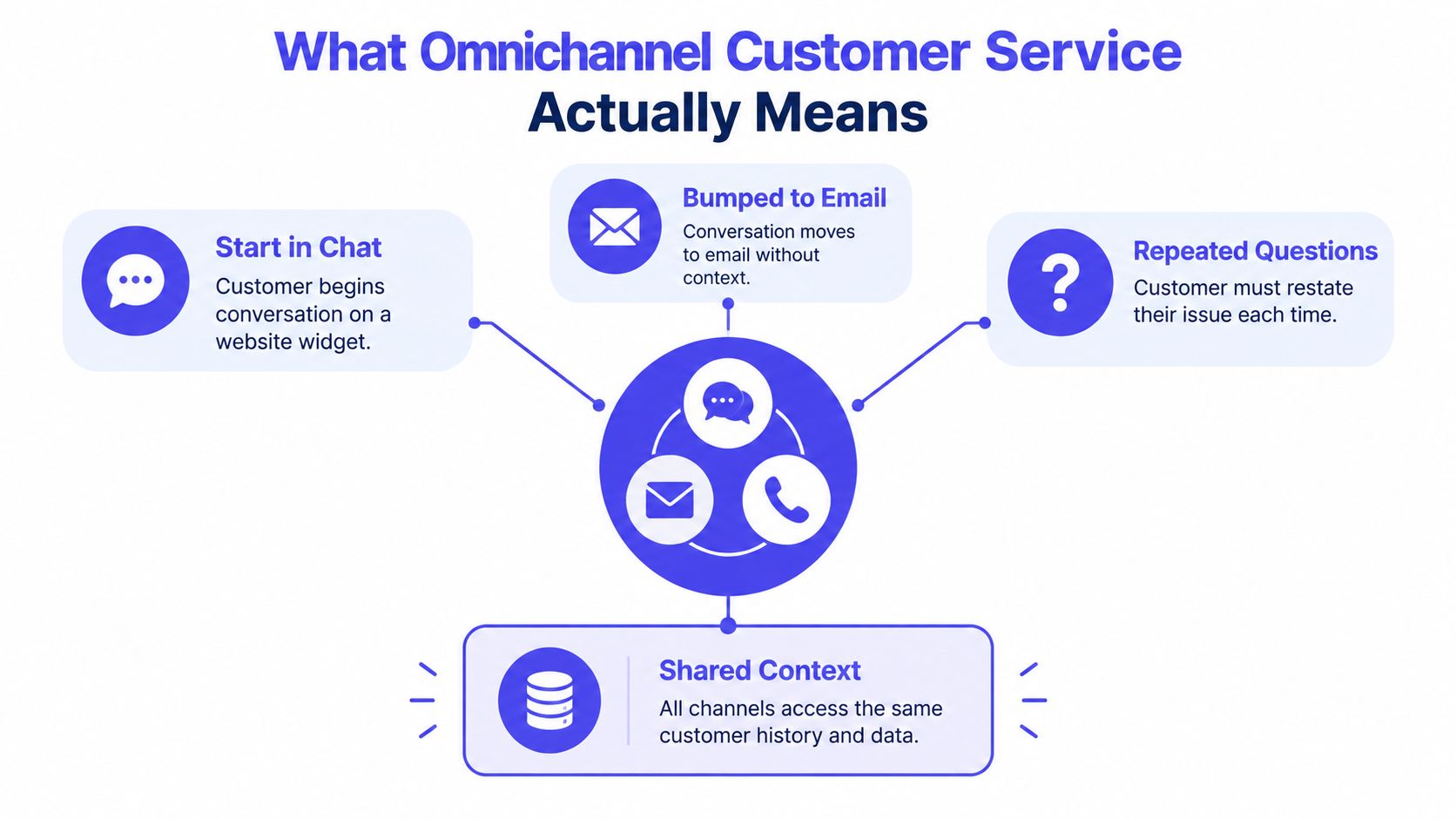
Omnichannel customer service connects channels through shared customer context. A chat, email, phone call, or social message becomes part of one ongoing support history. A multichannel team may offer all those options, but if each keeps a separate record, the customer still has to bridge the gaps.
That distinction matters because channel count is easy to increase and hard to manage. Every new queue adds another place for a conversation to lose its owner, status, or history. A shared record gives the team a better starting point: the next person can see what the customer asked, what the team tried, and what still needs to happen.
One survey makes the case. SQM Group, surveying more than 1 million customers, found satisfaction of 67% when the experience carried seamlessly across channels and 28% when customers had to start over. Nextiva’s own customer-patience survey adds that 56% of customers switched channels after a missed first contact, and 75% gave up after two or three attempts. The SQM and Nextiva figures are both summarized in a Nextiva-sponsored GeekWire piece on omnichannel customer service, so read the second as vendor data.
For a software team, continuity can be as simple as carrying a chat transcript into email, keeping internal notes and ownership visible in a shared inbox, or passing a question from an AI agent to a person with the prior conversation attached. The handoff should move the work forward, not give the customer another form to fill out.
The test: When a customer switches channels, do they have to repeat themselves?
Why Customers Now Move Across More Touchpoints
A Shopify merchant asks about a failed order in chat, sends a screenshot by email, then posts publicly when checkout still fails. To the customer, that is one problem. To a team with separate queues, it can look like three new tickets.
The purchase journey has also become more fragmented. Marketing Week reported that consumers use almost six touchpoints per purchase, against about two some 15 years earlier, with nearly half regularly using more than four, against 7% then; the figure is collected in this roundup of omnichannel statistics.
More touchpoints mean more routing decisions. Keep identity, history, ownership, and next action attached as the conversation moves. If a shared inbox carries those fields forward, chat, email, social, and docs can serve one relationship instead of five disconnected queues.
The same roundup cites an older Aberdeen Group figure: companies with very strong omnichannel engagement retained 89% of customers on average, against 33% with weak engagement. Treat that as a dated signal about continuity, not proof that a help desk alone creates retention.
Keep the record useful
A small software team does not need a dossier on every customer. It needs the facts that change the next reply:
- Identity: which person, merchant, or account is contacting you.
- Product context: which app, plan, storefront, or integration is involved.
- Conversation history: what they asked and what the team already tried.
- Current ownership: who has the next action.
- Issue status: whether the customer waits on an answer, a fix, or an update.
Capture what helps the next person act. Skip fields nobody uses. If the record cannot move cleanly from a chat transcript to an email thread to an internal note, the team added channels without adding service.
Choosing Channels by Urgency, Not by Trend
A channel earns its place when it helps the customer get the kind of answer they need. Don’t add phone support because another software company has it. Don’t force every urgent issue into chat because chat is easier to staff.
In a 2025 survey of more than 1,000 UK consumers commissioned by MaxContact, a contact-centre software vendor, 67% preferred phone for urgent matters, and 60% said phone resolved issues fastest, against 13% for webchat and 9% for email (The Voice of the UK Consumer 2025). That’s a useful warning for software founders: digital-first should not mean digital-only for every problem.
Use routing rules to match the channel to the customer’s need. A billing lockout or an issue disrupting a live store may warrant a scheduled call. A short product question may fit chat. An issue that needs screenshots or careful written steps may work better over email. If a customer raises a problem publicly on social media, acknowledge it there and move account details to a private channel.
| Customer Signal | Best-Fit Channel | What Must Travel With Them |
|---|---|---|
| Urgent issue, account access blocked, or live business disruption | Phone or scheduled call | Transcript, account identity, urgency, and actions already tried |
| Quick question about a feature or setup step | Chat | Customer identity and the page or product context, when available |
| Issue needs screenshots, logs, or a considered follow-up | Original request, attachments, owner, and response status | |
| Public complaint or question on social media | Public acknowledgment, then private support | Social message, customer identity if known, and the private follow-up history |
The tradeoff is staffing. Phone creates a synchronous commitment, while chat and email let a small team manage work asynchronously. Choose the smallest mix you can support well, and give each channel a clear escalation path. For teams deciding whether a website chat widget fits their support flow, this guide to a live chat widget for a website covers the practical considerations.
Five Pillars of Genuine Continuity
A shared inbox is only useful when the team can trust what it shows. Continuity depends on more than a transcript. The team needs to know who the customer is, what happened, who owns the next step, what state the issue is in, and which language or accessibility needs must be preserved.
The five pillars below turn that principle into things a small team can inspect. Track them in the help desk you already use before buying more software.
- Identity: Keep one customer record across channels. Measure repeat-contact rate and check whether the same person is appearing as separate records.
- History: Preserve one timeline when a conversation changes channel. Track how long it takes service to resume after a handoff.
- Ownership: Make the next responsible teammate visible. Review first-contact resolution and look for cases that stall because nobody knows who should act.
- Status: Give the customer a clear picture of what happens next. Use customer-effort feedback by channel to find moments when people have to chase updates.
- Language: Carry the customer’s preferred language and accessibility needs through every handoff. Review resolution rates by language instead of relying only on an overall satisfaction score.
A peer-reviewed study of 509 omnichannel fashion shoppers in Thailand (retail, not support) found that integrated customer service favorably influenced the omnichannel experience, and that the experience in turn carried the effect of ease of use (β = 0.160) and enjoyment (β = 0.130, both p < 0.05) through to satisfaction (study of omnichannel customer experience). For a support team, the practical point is that coordination can shape how the customer feels about the interaction, not just how quickly the team handles it.
Review the measures together. A fast handoff that loses the language preference isn’t a successful handoff. A complete transcript with no clear owner still leaves the customer waiting.
A Practical Implementation Path for Small Teams
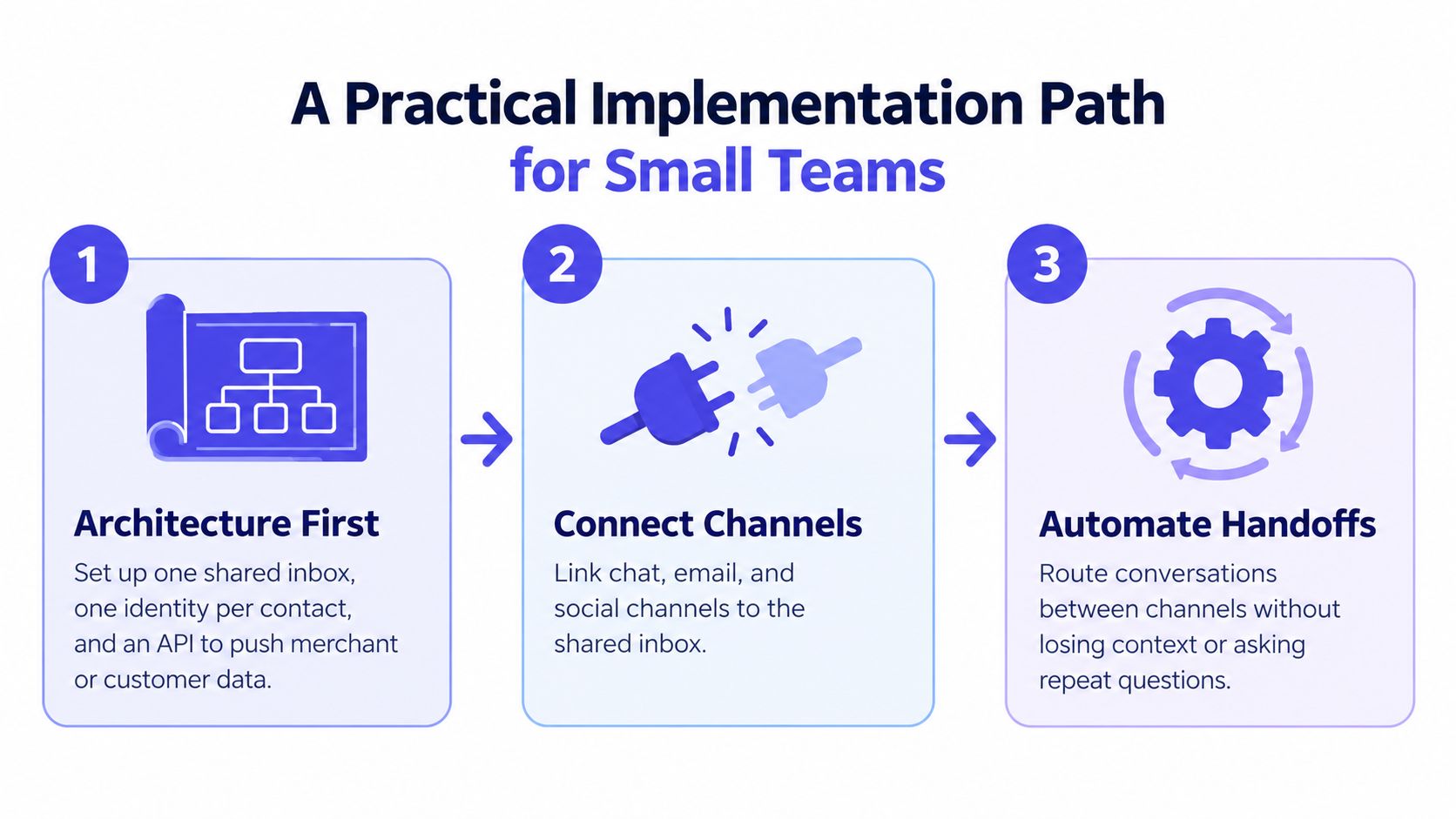
Start with the shared record, not a long list of channels. If your team can’t see the same customer history and account context, connecting more contact options will create more disconnected work.
First, connect the customer record
Choose one inbox where the team can see conversations, assign ownership, and leave internal notes. Add the customer or merchant details that change the answer. For software, that may mean account status, product, plan, and relevant billing history.
Then connect the channels your customers already use. Don’t build a custom integration before checking what your help desk supports. A useful guide to third-party integrations can help you think through which systems need to share data and which don’t.
A 2024 study of 516 omnichannel retail buyers in Peru found that integrating pricing, transaction and order-fulfillment information significantly shaped both the cognitive and the emotional side of the experience (2024 study of omnichannel retail experience). That is retail, not software support, so treat it as a loose analogy: account and transaction context should be available where the conversation happens.
Then, make handoffs explicit
Write down which requests stay in chat, which move to email, and which need a scheduled call. Assign an owner at every transfer. If you use an AI agent, set a clear boundary: when it isn’t sure, it hands off to a human. The person receiving the case should be able to see what the AI tried and what the customer already said. Handoffs are not rare edge cases: on Appointo, a Shopify app built by Sidepanda, the company behind Convot, Cove AI passed 235 of 808 customer messages (29%) to a person over the 30 days to 14 October 2026, because no answer met its confidence threshold (Convot data). Each of those is a moment where context either travels or gets lost.
A small team can run this in stages. Establish the shared record first, connect the most-used channels next, then review handoffs and repeat contacts during a regular support review. If workload grows and you need help with administrative coverage, a resource on where to hire Latin American virtual assistants can help you evaluate that option without confusing staffing with the need for better workflow.
Pitfalls That Quietly Break Omnichannel
Teams can connect the channels and still leave customers with a fragmented experience. The usual cause isn’t a missing feature. It’s an operating choice that makes context disappear at the exact moment someone needs it.
Watch the cost and the handoff
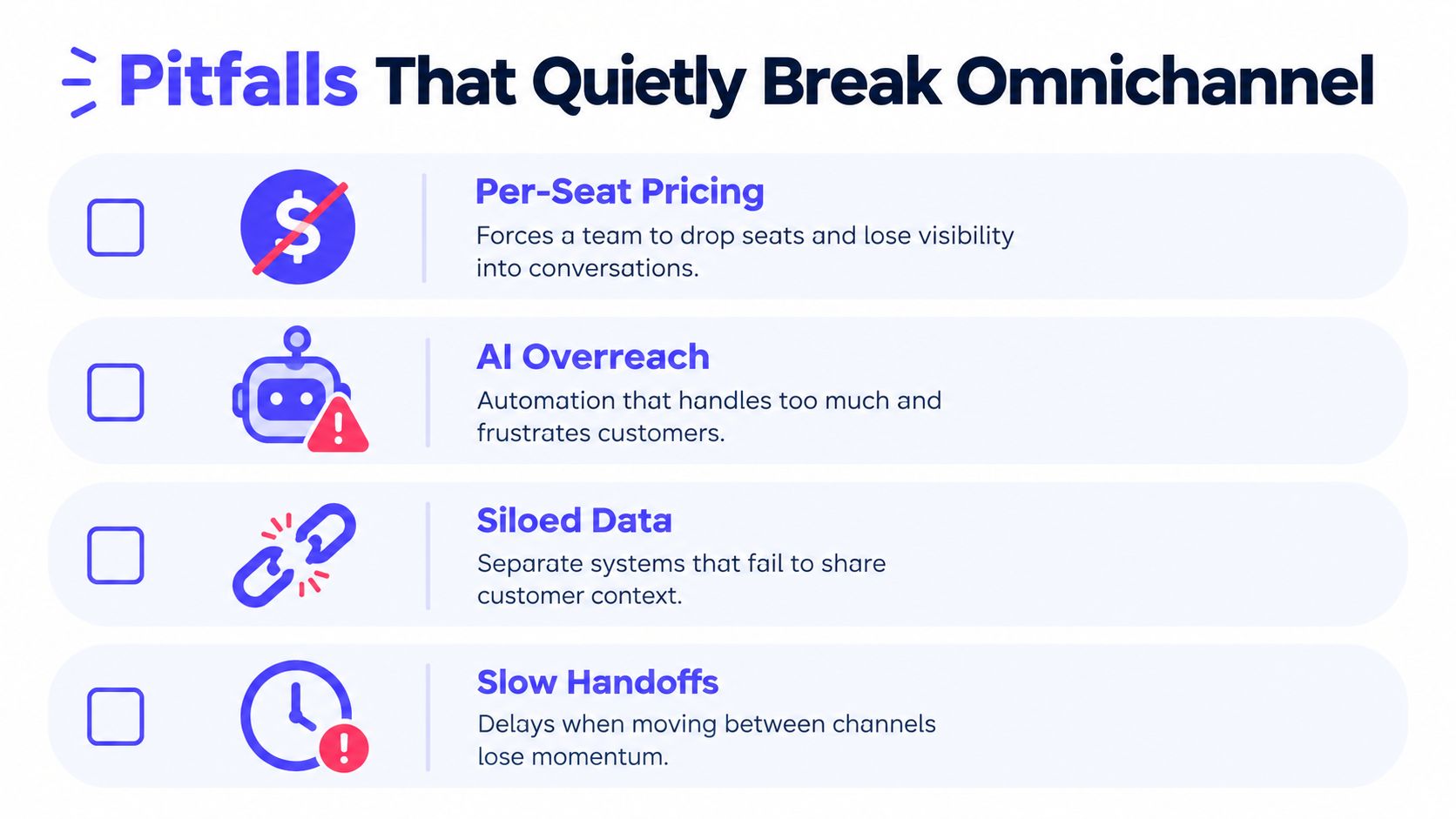
Per-seat pricing can create a quiet visibility problem. When a small team removes seats to control cost, fewer people may be able to see or own conversations. Check whether the pricing model encourages you to keep the right teammates involved, rather than treating access as a luxury.
AI can create a different kind of break. If the agent gives an outdated refund policy or hands off without the customer’s question and account context, it adds work instead of removing it. Review an AI-escalated conversation regularly, check the answer against the team’s own documentation, and make sure the human can see what happened.
A third failure is siloed data. If the customer record lives in one tool, the chat transcript in another, and the changelog somewhere else, a teammate must reconstruct the story manually. Keep only the systems you can connect and maintain.
Treat inclusion as continuity
Language and accessibility must travel with the customer too. Among certified UK digital identity services surveyed by the UK government in 2025, 73% offered at least one accessibility feature, about half offered more than one language, and 30% offered more than ten (UK government inclusion data). That is a narrow, adjacent sample rather than support-desk data, but it shows language and accessibility options becoming common. Having a language option is not enough if the customer is moved to a channel or person who can’t continue in that language.
Check whether a translated chat transcript keeps technical terms clear when it moves to email or a human agent. Record language and accessibility preferences where the support team can find them. If a translation seems uncertain in a billing, security, or troubleshooting exchange, route it to a person rather than letting automation guess.
Finally, keep customer-facing status information current. When an incident affects the product, tell customers what’s happening and update the message when the situation changes. A stale update creates another support request.
Shopify and SaaS Use Cases in One Inbox
A Shopify app developer shouldn’t have to investigate a billing dispute without knowing which app the merchant uses or what plan they’re on. That context can sit beside the conversation, so the first reply starts with the actual issue rather than a request to identify the account.
For a team supporting several Shopify apps, pricing by app count can make one inbox a practical alternative to separate support systems for each product. The merchant starts in chat, shares the billing concern, and the teammate sees the merchant’s plan, MRR, and past billing history next to the conversation. If the question needs a deeper review, the team can move it to email without losing the original exchange.
A SaaS team has a similar problem, but the journey may span more product touchpoints. A customer reads the help center, opens chat, checks a changelog, and books a call when the issue needs a longer discussion. A single support workspace can connect those steps, while an AI agent answers from the team’s own documentation and hands off to a human when it isn’t confident.
| Standalone Tool | Replaced By | Why Consolidate |
|---|---|---|
| Live chat | Shared support inbox | Keep the chat conversation with the customer’s support history |
| Separate help center | Help desk with connected knowledge base | Give customers self-service access and keep support answers aligned |
| Separate changelog and roadmap tool | Product updates connected to the support workflow | Let customer feedback and product updates live closer to support |
| Separate call-booking tool | Scheduling connected to support | Move complex issues to a call without losing the original context |
| Separate revenue dashboard for merchant context | Merchant information beside the conversation | Give the support teammate billing context without asking the merchant to repeat it |
Buying fewer tools isn’t automatically better. Keep a standalone product when it serves a distinct need your help desk can’t handle well. But don’t pay for separate systems by default when the team’s real requirement is one record, one owner, and a clear handoff.
The Minimum Viable Omnichannel Stack
A small team doesn’t need an enterprise contact-center project to make support feel connected. It needs a few deliberate choices and the discipline to check whether they work.
Make these decisions this week:
- Choose channels by need: Keep the options your customers use and your team can support.
- Unify customer context: Make identity, history, ownership, and account details visible in one place.
- Measure handoffs: Track repeat contacts, time to resumed service, and customer effort by channel.
- Review AI and language quality: Check whether automated answers and translations hold up when a person takes over.
- Keep access practical: Choose a pricing and permissions model that lets the right teammates see and own conversations.
If your current tools can support those decisions, fix the routing and process before replacing them. If they can’t, compare platforms based on how they preserve context, not how many channel logos appear on the pricing page. A shared inbox for support teams is one place to start when evaluating how conversations and customer history should fit together.
One disclosure: Convot makes a competing product. It’s a help desk for small software teams priced by number of apps with seats included, with Cove AI at $0.20 per resolved conversation and the Shopify merchant’s plan and billing history beside each conversation. See how the shared inbox works or compare plans.
FAQ
What is the difference between omnichannel and multichannel customer service?
Multichannel customer service offers several contact channels that each keep their own record. Omnichannel customer service connects those channels to one customer record, so history, owner and status move with the customer when they switch from chat to email or phone.
Which channels should a small software team offer?
A small software team should offer the channels its customers already use and its people can staff well, usually chat and email, with a scheduled call for urgent or account-blocking issues. Add social or phone only when there is demand and an owner for it.
How do you measure omnichannel customer service?
Measure omnichannel customer service by repeat-contact rate, time to resume service after a channel switch, first-contact resolution, customer effort by channel and resolution rate by language. A fast handoff that loses context counts as a failure.
Do you need an enterprise contact center for omnichannel support?
A small team doesn’t need an enterprise contact center for omnichannel support. One shared inbox that keeps identity, history, ownership and account context together covers the continuity customers notice first.
Convot brings live chat, a shared inbox, a help center, product updates, scheduling, and a grounded AI agent into one help desk for small software teams. If you’re a Shopify app developer or you’re consolidating support across several products, see Convot’s plans to check whether it fits your workflow.
Revenue-aware support for Shopify app teams.
Live chat, help center, and every merchant's MRR, plan, and LTV beside the conversation. Free under $1k MRR.
Start free